Trinity or Jeux de Rubans
Cartier · MIKIMOTO
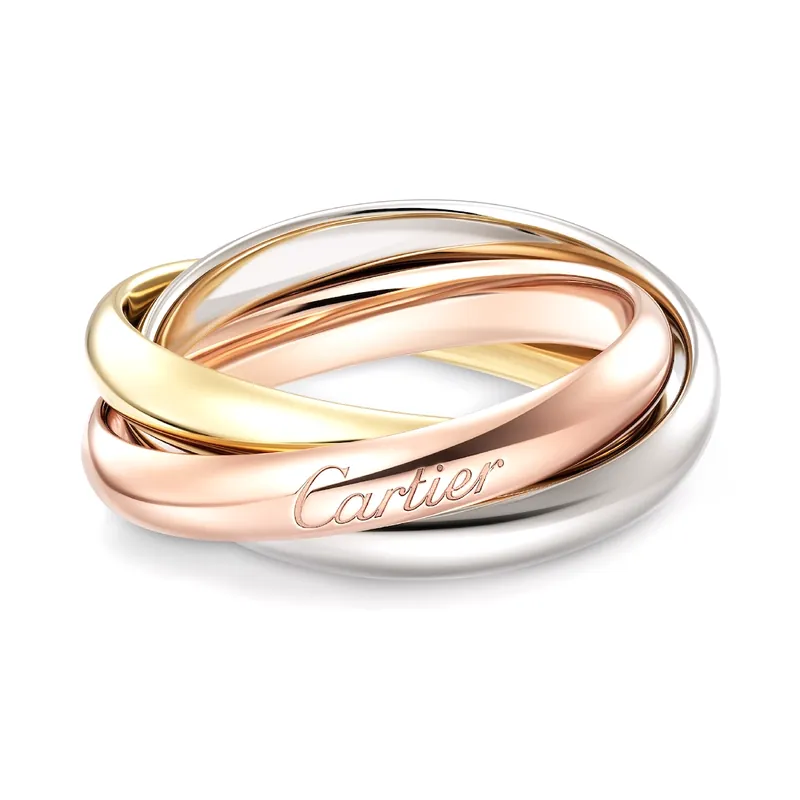
Trinity
Three rings of yellow, rose and white gold, linked so that they roll over one another on the finger.
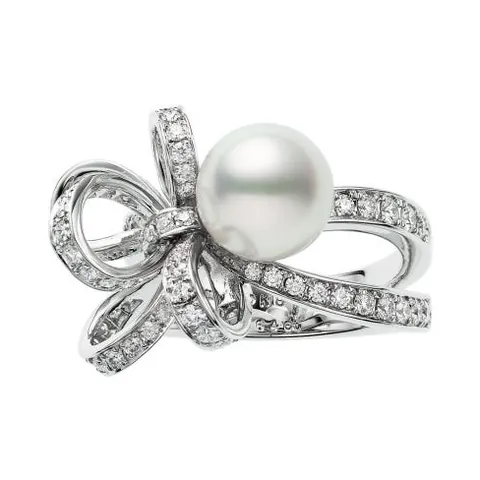
Jeux de Rubans
Ribbons of pavé white gold or plain pink gold loop and cross behind a single Akoya pearl, as if a present had just been tied.
Gold carries both pieces, but Mikimoto's ribbons exist to frame a pearl. Jeux de Rubans folds bands of pavé white gold or bare pink gold into loose loops behind a single round Akoya, like the bow on a present just tied. Trinity, linked by Louis Cartier in Paris in 1924, has no centre at all: three rings of yellow, rose and white gold, each holding the others. A Tokyo house of the pearl and a Paris house of the band answer the idea of binding in their own languages.
| Fact | Trinity | Jeux de Rubans |
|---|---|---|
| Introduced | 1924 | — |
| Designer | Louis Cartier | — |
| School | Place Vendôme | Tokyo |
| Materials | yellow gold, rose gold, white gold, diamond, ceramic, lacquer, cord | white gold, rose gold, pearl, diamond |
| Moves | rotates | No |
| From | €1,080 | €4,800 |
| Top of line | €67,500 | €15,300 |
Prices in euros as published by each house, October 2026.
More with Trinity
- Trinity or Jean Schlumberger by Tiffany Sixteen Stone Tiffany & Co.
- Trinity or Between the Finger Van Cleef & Arpels
- Trinity or Liens Chaumet
- Trinity or Chance Infinie FRED
More with Jeux de Rubans
- Jeux de Rubans or Jean Schlumberger by Tiffany Sixteen Stone Tiffany & Co.
- Jeux de Rubans or Between the Finger Van Cleef & Arpels
- Jeux de Rubans or Liens Chaumet
- Jeux de Rubans or Chance Infinie FRED