Solitaire 1895 or Glam'Azone
Cartier · Messika
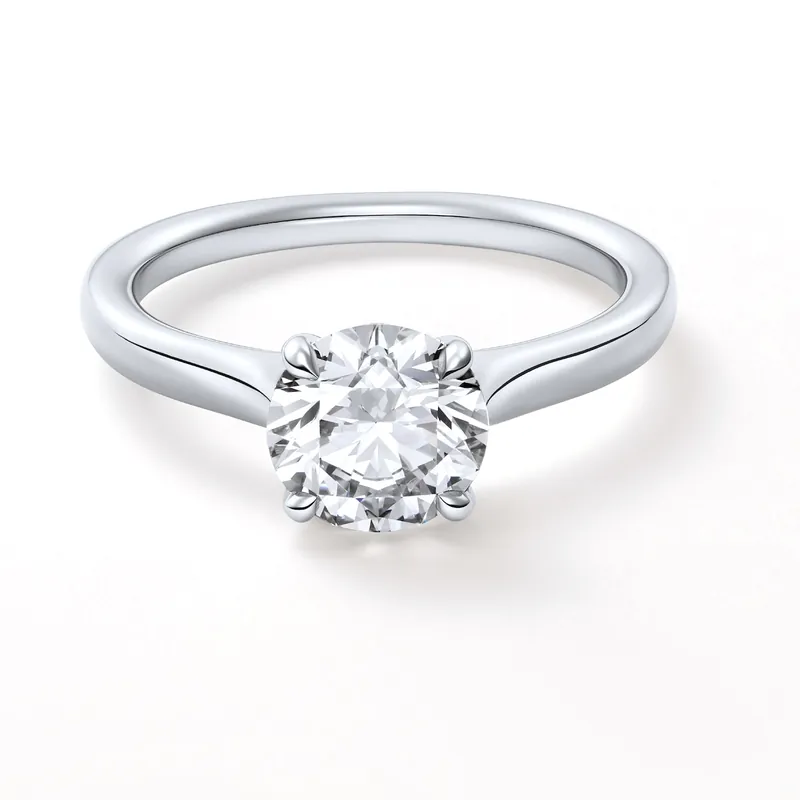
Solitaire 1895
One stone raised on four claws above a plain band, the house's barest answer to the engagement ring.
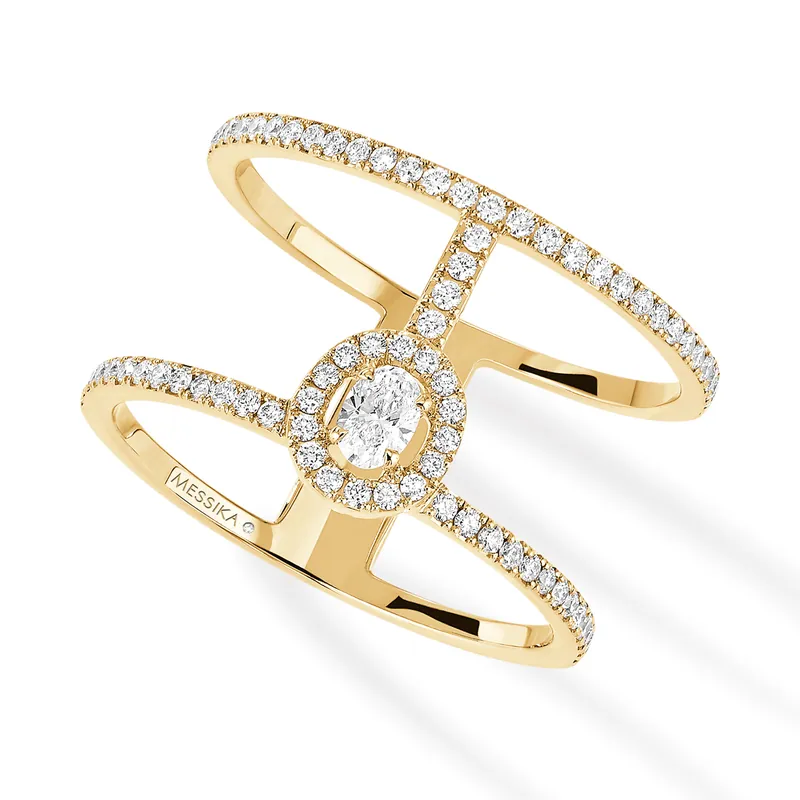
Glam'Azone
Two slim lines of gold cross the finger like an Amazon's arrow and spear and meet at an oval diamond held in a pavé halo, the shield.
Solitaire 1895 is a date and a stone: Cartier named it after the year its first solitaire appears in the archives, and sets it with four claws on a plain band. Glam'Azone is a narrative. Valérie Messika drew two thin gold shafts, an arrow and a spear, crossing the finger toward an oval diamond ringed with pavé, the Amazon's shield. The Cartier ring is pared to function. The Messika ring carries a small scene from Greek myth on the hand.
| Fact | Solitaire 1895 | Glam'Azone |
|---|---|---|
| Introduced | 1895 | — |
| Designer | — | Valérie Messika |
| School | Place Vendôme | Place Vendôme |
| Materials | platinum, yellow gold, rose gold, diamond, sapphire, ruby, emerald | yellow gold, white gold, rose gold, diamond |
| Moves | No | No |
| From | €930 | €2,990 |
| Top of line | €930 | €8,450 |
Prices in euros as published by each house, October 2026.
More with Solitaire 1895
- Solitaire 1895 or The Tiffany Setting Tiffany & Co.
- Solitaire 1895 or Le Cube Diamant dinh van
- Solitaire 1895 or Joséphine Chaumet
- Solitaire 1895 or Serti sur Vide Repossi
More with Glam'Azone
- Glam'Azone or The Tiffany Setting Tiffany & Co.
- Glam'Azone or Le Cube Diamant dinh van
- Glam'Azone or Joséphine Chaumet
- Glam'Azone or Serti sur Vide Repossi