The cabochon
Same idea, three houses.
Lineage
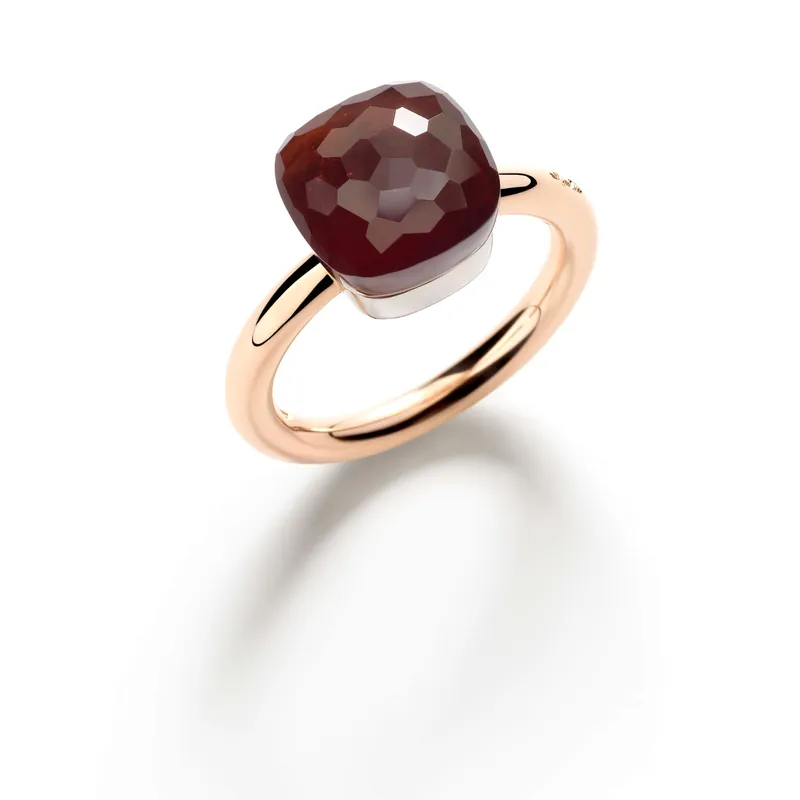
- 2001 Nudo Pomellato
- 2013 Pain de Sucre FRED
Pain de Sucre answers Nudo · 2013
Pain de Sucre shares Nudo's taste for colour over fire and raises it into a tall sugarloaf cabochon that can be changed at will.
Where it came from
Caboche is Middle French for a head, and a cabochon is a stone shaped like the top of one: polished into a dome, flat underneath, without a single facet. It is the older way to treat a gem. Before cutters learned to facet, it was the usual method, and some stones still demand it, since a star sapphire shows its star, and a cat's-eye chrysoberyl its eye, only under a curved surface. What the dome gives up in fire it returns as colour, light that seems to sit inside the stone.
Cartier and Bulgari brought the dome back to the front of the jewel. The first fully sculpted Cartier panther, made in gold and enamel for the Duchess of Windsor in 1948, came with a cabochon emerald. In Rome, Bulgari introduced cabochon cuts among its multicoloured jewels in the late 1950s, the decade Elizabeth Taylor became one of its best-known clients.
Two recent rings play with the dome. Pomellato's Nudo of 2001 sets a square of coloured stone, faceted across its domed top, on a bare rose-gold shank with no claws. FRED's Pain de Sucre of 2013 borrows the tall shape of a sugarloaf and clips the cabochon into its gold mount, so topaz can give way to turquoise, amethyst or rose quartz.
Side by side
- Pain de Sucre or Nudo FRED · Pomellato
- Nudo or Freccia Pomellato · Vhernier
- Pain de Sucre or Freccia FRED · Vhernier